Saturday, May 29, 2010

THE CASTLE OF LOURDES

The Fortified Castle of Lourdes

Lourdes is dominated by its historic castle, the Chateau Fort of Lourdes, in the Hautes-Pyrenees Departement of France. Built on a rocky promontory overlooking the town of Lourdes, this immense castle has witnessed battles, bloodshed, sieges and destruction for centuries. Because of its strategic position at the entrance of the seven valleys of the Lavedan, the castle has played a prominent role in the history of Lourdes. It was first used by the Romans as a military encampment and was gradually enlarged and strengthened with the passage of time. For centuries, this fortified castle has remained virtually impregnable. Located on the right bank of the Gave de Pau, a river of south-western France, this medieval castle was also known as "Mirambel" during the middle ages. From the castle, visitors can enjoy a panoramic view of the town of Lourdes.
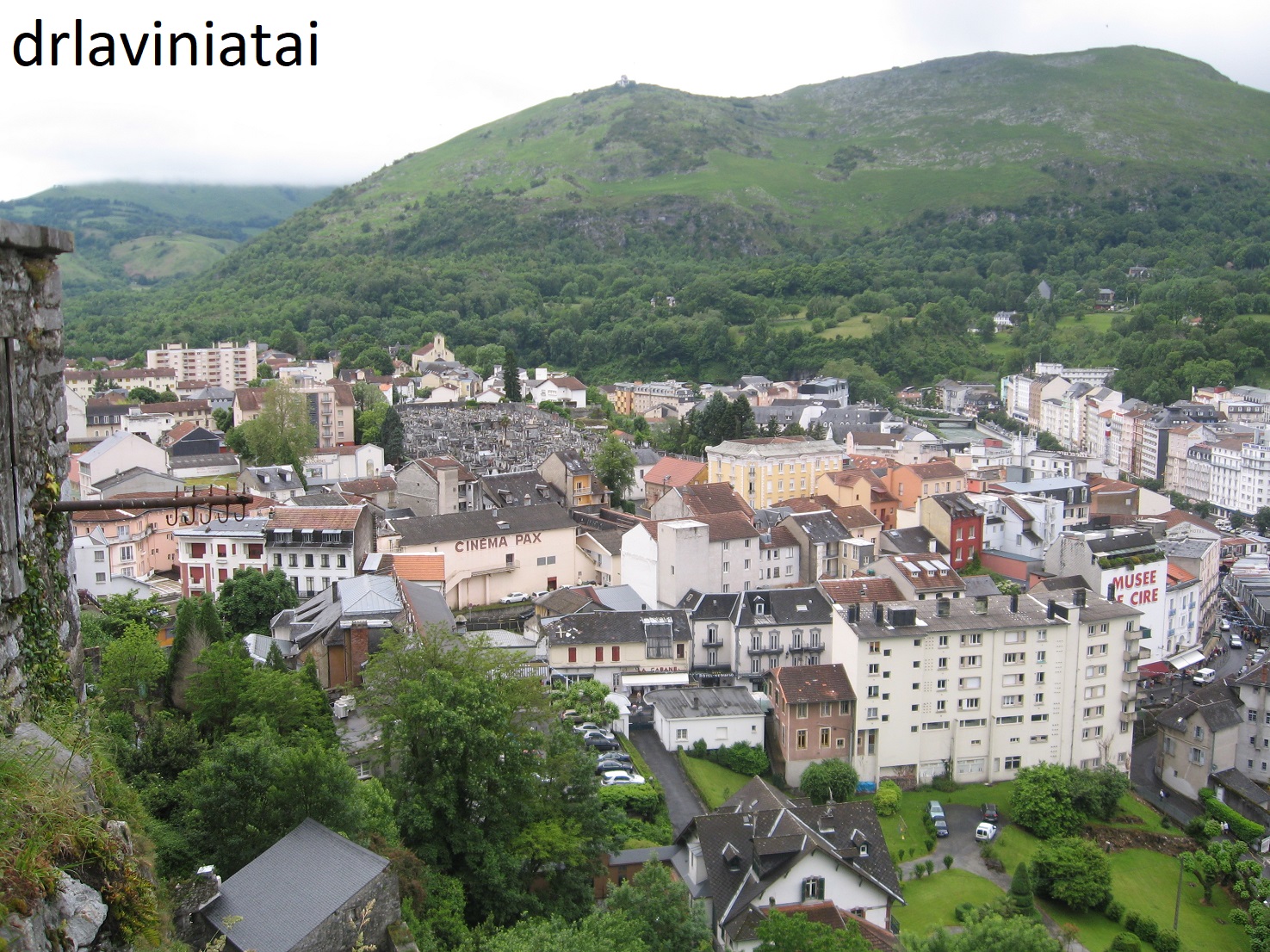
A panoramic view of the town of Lourdes from the castle

The beautiful town of Lourdes (view from the castle)

The Gave de Pau river running through Lourdes (view from the castle)

A beautiful view of the Basilica of Saint Pius X from the castle

The Castle of Lourdes and its surrounding areas have a very interesting history which dates back to the Roman Era. The Vandals invaded Gaul (France) in the year 406. This ancient "barbarian" Germanic tribe not only massacred the elderly, women, and children, but also razed to the ground everything they found in their path. The Visigoths who invaded Gaul after the Vandals laid siege to the castle, took control of it, and used it to strengthen their defenses. The castle was occupied by the Saracens in the 8th Century after they were defeated by Charles Martel at Poitiers in 732. In 778, Charlemagne laid siege to the castle occupied by the Saracens and captured it. According to a legend, Mirat the Saracen leader, was about to surrender due to starvation when an eagle dropped a trout at his feet. The coat of arms of Lourdes, which consists of an eagle with a trout in its beak perching on a castle, still bears witness to this legend. Here the story goes:

The Eagle and the Trout
In 778 AD, the year of the Battle of Roncevaux Pass, the Charlemagne besieged the fortress of Lourdes, occupied by the Saracens. As they were on the brink of starvation, an eagle flew above the castle with a trout in its beak and dropped it at the feet of Mirat, the Saracen leader. Mirat sent the trout to Charlemagne with the message that he still had lots of food and would never starve. Charlemagne was about to give up the siege when the Bishop of Le Puy-en-Velay suggested that Mirat should surrender, not to the emperor, but to the Mother of God. And of course he did. Mirat and his men not only surrendered to Charlemagne but to the Blessed Virgin Mary and were converted. Mirat was baptised and took the Christian name of Lorus. He became the governor of Lourdes and the town was named was named after him, which in the course of time, became known as Lourdes. 

In 841, the Castle of Lourdes was attacked by the Normans but they failed to capture it. However, the castle was subsequently occupied by the Albigenses, French, and English. In 1195, the castle became the property of the viscount of Tartas after which it was passed from hand to hand. In 1216, Simon de Montfort tried to take the castle but his attempt failed after a short siege. In 1314, Charles the Fair restructured and fortified the castle to enhance the region's defence capability. In 1322, he became the King of France (Charles IV) and the castle became crown property. In 1361, during the Hundred Years' War, Bigorre was ceded to the Prince of Wales who also known as the black prince. He entrusted the castle to Peter-Arnold and John of Bearn who set about looting the area with the Gascon mercenaries. Attempts to besiege the castle by the duke of Anjou and Du Guesclin in 1373 failed and it was not until 1377 that Gaston Phoebus was able to recapture the castle for the Emperor of France. However, the English were not completely driven out until 1407.

The Count of Clermont seized the castle during the conquest of the "seven valleys" in the year 1404 but returned it to the Emperor of France, Charles IV, in 1406. In 1425, the castle became the property of the House of Foix. The castle also had a prominent role to play when the Wars of Religion between the Catholics of Bigorre and the Huguenots were raging throughout the country from March 1562 to April 1598. During this period of violence, the town of Lourdes was captured and recaptured, plundered and pillaged. In 1607, when Bigorre became part of France and peace was restored, the castle became crown property. The Emperor of France, Henry IV of Navarre from the House of Bourbon, commissioned the restoration of this castle.

During the French Revolution and the reign of Napoleon, the castle became a state prison, where famous inmates were imprisoned, and these include the Duke of Mazarin, the French philosopher Maine de Biran and General Bourbaki. In the Nineteenth Century, the castle was converted into army barracks. The municipal administration of Lourdes bought the castle for 50000 gold francs in 1893.

Following extensive restoration in 1921, the castle was transformed into a beautiful Pyrenean Museum under the initiative of Louis Le Bondidier and his wife, Margalide. As stated by Louis Le Bondidier, "nothing that is from the Pyrenees should be foreign to us" which is clearly proven by the "pyreneism" of the museum and its intention to revive the art and traditions of this great historical period. The exhibits of the museum include traditional costumes, furniture, agriculture tools, crockery, musical instruments, artifacts, and everyday objects. Visitors can also see a reconstructed Bearn kitchen and Bigourdan bedroom of the 19th Century. These excellent historical displays enable the visitors to explore and discover the cultural richness of Lourdes over the centuries. The Castle of Lourdes, which symbolizes the history of the town of Lourdes, was listed as a National Heritage Site by the French Ministry of Culture in 1933. Now completely restored, it is one of the most visited museums of traditional arts and crafts in France.

Chateau Fort Pyrenean Museum

Chateau Fort Pyrenean Museum

Chateau Fort Pyrenean Museum

Chateau Fort Pyrenean Museum

Chateau Fort Pyrenean Museum

There are lifts to take the visitors up to the main terrace of the castle. Alternatively, visitors can take the 156 steps Saracens' Staircase and enter through the Charlemagne gate or the Assommoir gate. From the castle terrace, visitors can see the magnificent views of the sanctuaries of Lourdes, the Gave de Pau, the town of Lourdes and the Pyrenees. The crenellated tower is 24 metres high and there is a 104 steps curving staircase to take visitors to the top of the tower. And do remember to visit the "Our Lady of the Castle" chapel. You will be able to see some of the gilt-covered wooden statues from the original parish church of Lourdes which was destroyed by fire and demolished in 1905. These include the Madonna with child, St. John the Baptist, St. John the Evangelist, St. James of Compostela and St. Lucy.

View from the castle terrace

 View from the castle with the Pyrenees in the background

 View from the castle terrace

Within the walls of the castle, there is also a beautiful botanical garden. At the central courtyard of the castle, you will be able to see the beautifully designed miniature reproductions of historic Bigorre and Bearn abbeys, castles and monuments.

Miniature historical reproduction

Miniature historical reproduction

A very nice reproduction of Bigorre

Miniature historical reproduction

Miniature historical reproduction

The castle is within walking distance from the center of the town but I have never walked there before as I preferred to take the Little Train of Lourdes. It is a very interesting place and really worth visiting.Believe me, you'll love everything that you see there.

You may also like to read LOURDES: THE PIC DU JER AND THE FUNICULAR. To read more about Lourdes, please click here to view the content page of this blog. There is a complete list of my articles about Lourdes on this page.


References:
1.  Lourdes and Bernadette by Antonio Bernardo. Publisher "il Calamo"
2.  Discover Lourdes. MSM.
3.  Lourdes: Apparitions, Message, Pilgrimage. MSM.
4.  Lourdes: In Bernadette's Footsteps. MSM.
5.  Lourdes History. Editions A. Doucet - Lourdes.
6.  Lourdes by Antonio Bernardo. Doucet Publications.


Sunday, May 16, 2010

MURDER AT GOLGOTHA - REVISITING THE MOST FAMOUS CRIME SCENE IN HISTORY

12th Station, The Way of the Cross, Lourdes

More than two thousand years ago, Jesus Christ was murdered in cold blood, in broad daylight, between A.D. 30 and 33. The famous crime scene is known as Golgotha, which means "Skull" in Aramaic, a skull-shaped hill located immediately outside the walls of Jerusalem.


In the Garden of Gethsemane
The night before his crucifixion, Jesus underwent agony in the Garden of Gethsemane before He was betrayed and arrested. While praying in the garden, Jesus experienced hematohidrosis, an extremely rare medical condition which resulted in the excretion of blood in the sweat.

In His anguish he prayed with all the greater 
intensity, and His sweat became like drops of
blood falling to the ground. (Luke 22:44)

Luke, a physician by profession, had written in his testimony, that Jesus' sweat fell to the ground like drops of blood. Why did Jesus "sweat blood?" According to the renowned Dr. Frederick Thomas Zugibe, formerly the chief medical examiner of Rockland County (1969-2003) and one of the most prominent forensic experts in the United States, this condition is known as hematohidrosis and is associated with extremely severe mental / emotional distress due to intense anxiety and fear. When Jesus was in great spiritual agony knowing that He would be sentenced to death and nailed to the cross, He experienced a classic "fight or flight" response. Under such circumstances, His body released adrenaline (the fight or flight hormone) which would have made His heart beat faster, increased His blood flow, and caused His blood sugar levels to spike.  He would have breathed faster to increase His oxygen intake and this would have been followed by extreme physical tiredness. His blood vessels first constricted (under intense anxiety) and then dilated to the point of rupture (when the anxiety passed out). When the blood vessels around his sweat glands ruptured, the blood, having mixed with sweat, oozed out from His skin. Needless to say, the loss of both blood and sweat this way would have left Him dehydrated in Gethsemane but this was just the beginning of His sufferings. 


The Trial of Jesus 
After His agony, Jesus was led from the Garden of Gethsemane to Annas, the  former high priest and father-in-law of the high priest, Caiaphas . Whenever Jesus made a pertinent remark, such as saying how openly He had taught in the synagogues or temple areas, the guards standing nearby stepped in to give Him a good beating.

At this reply, one of the guards who was 
standing nearby gave Jesus a sharp blow 
on the face, "Is that the way to answer 
the high priest?" he said.
(John 18:22)

Annas then sent him firmly bound to the high priest, Caiaphas. According to the Matthew, Mark, and Luke versions of the Bible, Caiaphas ultimately asked Jesus the major question of whether he was the Messiah, the Son of God.

Jesus answered: It is you who say it. But 

I tell you this: Soon you will see the Son of 
Man seated at the right hand of the Power 
and coming on the clouds of heaven. 
(Matthew 26:64)

At this the high priest reportedly tore His robes as a ritual token that Jesus had signed His own death warrant. He pronounced that as Jesus had blasphemed, they needed no further witnesses. All those present on the interrogation side that night had collectively agreed that Jesus deserved the death penalty. 

Then they began to spit in His face and hit him.
Others slapped Him, saying: "Play the prophet 
for us, Messiah! Who struck you?"
(Matthew 26:67-68)

The Matthew, Mark, and Luke versions have all indicated that the guards behaved violently towards Jesus whilst the interrogators did nothing to stop them. At daybreak, Jesus was bound and handed over to the Roman governor, Pontius Pilate to be tried. Due to pressure from the crowd, he sentenced Jesus to be scourged and then crucified.


The Scourging of Jesus: Visions of the 19th-century German nun, Sister Anne Catherine Emmerich (1774-1824)
Sister Anne Catherine Emmerich possessed the gift of seeing the past, present and future and in a series of ecstatic visions in 1823, she beheld Jesus' last supper, His agony in Gethsemane, His arrest and trials, the way of the cross and His crucifixion. It was Sister Anne Catherine Emmerich's visions of Jesus' passion that inspired Mel Gibson's movie The Passion of the Christ. What happened during the scourging of Jesus? According to her: 

The executioners arrived, carrying whips, rods, and ropes... There were six of them.... They looked like wild beasts or demons, and appeared to be intoxicated... Two furious ruffians who were bloodthirsty began to scourge His sacred body from head to toe in the most barbarous manner ... Our Lord writhed like a worm under the blows of these savage beasts... A strong bright red liquid was brought to them... they became greatly drunk and intoxicated thus increasing their cruelty tenfold towards our Lord. They continued to strike our Lord for a quarter of an hour.... Jesus was bleeding profusely and His body was entirely covered with black, blue and red marks.... These two ruffians were succeeded by two others who made use of different rods, thorny sticks covered with knots and splinters.... The blows from these sticks tore our Lord's flesh to pieces.... His blood spurted around and stained their arms.... They were replaced by two fresh executioners whose scourges were made of small chains, or straps covered with iron hooks, which tore off large pieces of flesh and skin at every blow... The body of our Lord was completely torn to shreds... The terrible scourging lasted for three-quarters of an hour.


Jesus Was Sentenced to Death

Mel Gibson's movie, The Passion of the Christ, is the only movie which clearly shows the emotion, pain and passion of the crucifixion of Jesus as it retells the last twelve hours of Jesus' life on Earth in great detail. Many critics are of the opinion that this movie may be too bloody and violent but, according to the visions of Sister Anne Catherine Emmerich, that was exactly how our Lord was tortured to death. I really can't imagine how Jesus could endure all the pain and sufferings in His passion. The scourging had rendered Him a very pitiful sight with His entire body wracked with pain and covered in bleeding crisscrossing canals. The scourges which ripped and punctured his flesh caused blood to ooze out from breaks in the skin all over His body. However, the Roman soldiers still had not finished with Him. According to the Gospel of John:

The soldiers then wove a crown of thorns and 

fixed it on His head, throwing around His 
shoulders a cloak of royal purple. Repeatedly 
they came up to Him and said, "All hail, 
King of the Jews!", slapping His face as 
they did so. (John 19:2-3)

One of the sadistic Roman soldiers hit on the idea of making a mock crown out of some thorn branches and then jammed it into Jesus' head to make fun of Him. He even threw an old cloak over Jesus' bloody shoulders, as a "royal robe" and paid Him mock homage saying "All hail, King of the Jews" to complete his action. In all history, Jesus is the only individual ever recorded to be given such a mockery and derision. It is all too painful to imagine how the innocent Jesus who was in intense pain could be treated in such an inhumane way.

Was Jesus subjected to further violent and inhuman punishment before he was crucified? Definitely. The mocking "King of the Jews" cloak was removed from Him and His own clothes was put back on Him. No doubt, this would inevitably reopen all His wounds and cause more bleeding. He was then made to carry the large crossbeam on which He would be crucified. The soldiers led Him out of the Praetorium on what would be His final journey - along the Via Dolorosa to Golgotha. During His journey to Golgotha, He was again beaten by the guards. He was so weak that Simon of Cyrene had to carry the cross with Him.

What was crucifixion like during the Roman Empire? First, the victim was stripped of his clothing. Just imagine how painful it is when a bandage is pulled very strongly from our bleeding skin and how many times worse this would be if the bandage is large enough to totally cover the entire body! Stripping Jesus of His clothing was equivalent to ripping off the bandage stuck to His wounds forcefully and since that was not the first time they did it, reopening all His wounds again and again causing excessive bleeding would certainly be much too painful for Him to bear.

The next stage of the Roman crucifixion procedure was to nail the victim to the cross. To support the weight of an adult body on the cross, strong and heavy nails of at least six inches long had to be used. Unlike what we often see in the crucifixion pictures, Jesus was nailed to the cross via His wrists rather than His palms as the former would be unable to support His weight. Driving the nails into His wrists would have injured the median nerve and caused extreme pain, a condition known as causalgia. According to Dr. Frederick Zugibe: 

The pain is exquisite and equivalent to an
incessant, burning or searing sensation 
that is so intense that even gentle contacts
like clothing or air drafts can cause utter
torture. The pain is unbearable, like a
lightning bolt traversing the arm. Victims 
of  causalgia often go into profound shock
if the pain is not alleviated promptly.

Needless to say, lifting up the crossbeam with Jesus hanging from it would have triggered even greater pain! What would have been the effect of nailing Jesus' ankles to the cross? The discovery of the remains of Jehohanan (a victim of crucifixion) in Giv'at ha-Mivtar shed some light on this. His legs were spread and let to dangle either side of the cross and his ankles were then nailed to these sides. Hammering one nail through each ankle would certainly have been as devastating on Jesus' nerves as driving the nails into His wrists as the pain would have been as unbearable as the causalgia caused by His wrist injuries. That was how Jesus was crucified - even though He had done nothing wrong but heal, teach, and preach the good news of the kingdom of God.

For further reading about the passion of Jesus, please refer to Ian Wilson's Murder at Golgotha - a direct reaction to Mel Gibson's much-talked-about movie The Passion of the Christ. This book gives a marvelously detailed account of the last moments of Jesus' earthly life. 

You may also like to read LOURDES PILGRIMAGE - GOING UP CALVARY HILL WITH JESUS. To view the content page of this blog, please click here.


References:
1.  Wilson, Ian. (2006). Murder at Golgotha: Revisiting the Most Famous Crime Scene in History. New York: St. Martin's Press.
2.  Emmerich, Anne Catherine. (1923). The Dolorous Passion of Our Lord Jesus Christ. New York: Dover Publications.
3.  Zugibe, Frederick T. (2005) The Crucifixion of Jesus: A Forensic Inquiry. New York: M. Evans and Company, Inc.
4.  The New American Bible. New York: Thomas Nelson Publishers.


Monday, April 26, 2010

IS MEDJUGORJE A HOAX AND A MONEY MAKING SCAM?

Our Lady of Medjugorje

For weeks I have not really been writing anything for my blog because I really couldn't find the time. But I will try to write something tonight with the little time I have. What prompted me to write tonight's article? I have been browsing the web looking for articles about Medjugorje, and, as usual, I came across many negative things about Medjugorje. The question I would like to answer tonight is, "Is Medjugorje a hoax and a money making scam?"

Before I proceed any further, I would like to ask these questions? Are we being deceived by Medjugorje? Why do we go to Medjugorje in the first place? To pray and to spend some precious moments with the Lord. To be with our Blessed Mother and to share some beautiful moments with Her. To spend some quiet moments pondering over our lives and to find ourselves. To ask the Lord and His Blessed Mother what they want from us. To experience the peace that we seldom find back home. Can we say that we are being deceived to do such things? Well, I would say that it's a great blessing to be able to get so close to Jesus and our Blessed Mother in this holy place. And of course no one can force us to do these things if we don't want to.

The reason why I went to Medjugorje is clearly explained in my first article on this blog and I do not wish to reiterate here. Suffice it to say, Our Lady has personally invited me to be with her in this place of grace. If our Blessed Mother wants us to be there, we will get there somehow. Anyone can say anything about Medjugorje but your instinct will guide you to the truth. Just follow your instinct and do what is right. It is not for anyone to tell me that the visionaries are telling lies or telling the truth as I always look at the evidence from both sides. Finally, it was the feeling of Our Lady's presence in Medjugorje that brought me to this place - I have not been duped. I suppose the same applies to all those who have been to Medjugorje. If someone were to tell you that there is a goddess in the moon, I am sure you would not believe it until you have found proof of it. We are not fools. We all have brains and we can know what is right and wrong by listening to our conscience.

In Medjugorje, I could see the pilgrims praying the rosary everywhere - in the Church, on their way to the shops, while they were climbing Podbrdo Hill and Mount Krizevac, and while they were on their way to the Church. Those who seldom pray would suddenly find themselves praying for hours each day and those who seldom attend Church would attend Church several times a day. Why? Because this is the way of life in Medjugorje as it is not possible not to pray or attend Church in Medjugorje. These are the good fruits of Medjugorje and it would certainly be unfair to say that the pilgrims are duped into saying their prayers or going to Church. 

What about the Medjugorje conversion stories? Many pilgrims who have visited Medjugorje discovered that their faith was rekindled and are now happier with their lives. Is this a hoax or a scam? And what about their great experience of peace and the grace they have received from Our Lady during their amazing journey to Medjugorje? Is this what is meant by the Medjugorje deception? Well, if Medjugorje can make us profoundly wiser, better, and more religious, then, what is wrong with this place? Why the controversy? My advice is - follow your heart. That was what I did and my heart brought me there. And I have never regretted my pilgrimage to Medjugorje because I found myself there. Our Lady of Medjugore has been appearing to the visionaries for nearly 30 years since 24 June 1981 - is that not enough to stand the test of time?

Is Medjugorje really a money making scam? What kind of money making scam is Medjugorje involved in? Surely there is nothing wrong making an honest living providing food and lodging for the pilgrims? Do you know that Medjugorje has the cheapest hotels in the world? And surely there is nothing wrong selling souvenirs to the pilgrims at reasonable and affordable prices? Whether it is Lourdes or Fatima or the Vatican City, the pilgrims need a place to stay and they need food. They will only be too glad if they can find a wonderful hotel where they can stay comfortably and enjoy good food. Nobody wants to live on the streets with all those luggage. Nobody wants to bring along instant noodles and do their own cooking on the streets in Medjugorje. I wouldn't want to camp on the streets and cook instant noodles for my meals. That would be most unpleasant. And talking about the souvenir shops in Medjugorje, they really made me very excited because I am a shopping addict! Without those souvenir shops, life would be very dull and boring as I am the kind of person who enjoys looking at the things I buy after going on a shopping spree and feeling happy just looking at these things.

Come to think of it, I had a comfortable stay in Medjugorje. I had a beautiful and spacious hotel room with a beautiful scenery and good food to eat. I was glad that I had so many things to buy there and have enjoyed my shopping very much - thanks to the beautiful souvenir shops. I always become very much alive whenever I go shopping. When I saw the souvenir shops and so many of them too, my heart really leapt with joy. I am so proud of the Medjugorje books and souvenirs that I brought home with me. My room is full of them and they always make me feel close to Medjugorje. What if there were no souvenir shops in Medjugorje? As a great shopper, I would be really sad if I couldn't do any shopping in Medjugorje. I would hate to return home empty handed.

No one forces us to go to Medjugorje. We go there out of our own free will. In fact we should be thankful to the people of Medjugorje for making our stay there so pleasant, comfortable and enjoyable. They are only making an honest living. They have never tricked us to go there or forced us to part with our money. And they are very honest people. They have never asked for more than they deserve. 

Thanks for reading. You may also like to read IS MEDJUGORJE A SATANIC CULT?MEDJUGORJE: FAITH OR FRAUD?THE MIRACLES OF MEDJUGORJETESTIMONY OF FATHER LUKA SUSAC; and TESTIMONY OF FATHER UMBERTO LONCAR. To view the content page of this blog, please click here


Thursday, April 22, 2010

QUOTATIONS FROM THE BIBLE

The Bible: Authorized King James Version with Apocrypha (Oxford World's Classics)

There are moments in life when we are depressed and feel that we are going nowhere because life has lost its meaning and purpose. Whether it is failure in an examination, losing a job, illness, death of a loved one, divorce or broken relationships, these can be very stressful and discouraging to all those involved. The words of the Bible are often sought when we need guidance and strength as they clearly remind us of God's promises and presence. Reading inspirational Bible verses is an excellent way to tide over the unfavorable circumstances in life and restart one's life all over again. Have faith and strengthen your relationship with God and and you will see light at the end of the tunnel. In this article, I would like to share 30 inspirational Bible verses and quotes with my readers. I hope that these would uplift their spirit and help them to keep on going with life no matter how hopeless or bleak the world seems to be. Remember, never give up because God is always by your side.


Exodus 15:2
The Lord is my strength and my courage, and he has been my salvation. This is my God, and I will praise Him; the God of my father, and I will exalt him.

Deuteronomy 20:4
For the Lord your God is the one who goes with you to fight for you against your enemies and give you victory.

Deuteronomy 31:6
Be strong and courageous; have no fear or dread of them, for it is the Lord, your God, who marches with you; he will never leave you or forsake you.

Joshua 1:9
I command you: be strong and courageous. Do not be afraid or be discouraged, for the Lord your God is with you wherever you go. 

Psalm 37:5-6
Commit your way to the Lord; trust in him; and he will bring it to pass. He will make justice dawn for you like the light, and your vindication like the noonday sun.

Psalm: 37:12-15
The wicked plot against the righteous, and gnashes his teeth at them. But the Lord laughs at the wicked: for he sees that his day is coming. The wicked draw the sword, and bend their bows, to bring down the affiliated and the needy, and to slaughter those whose path is right. But their swords shall pierce their own hearts, and their bows shall be broken.

Psalm 37:18-20
The Lord watches over the life of the wholehearted; their inheritance will endure forever. They are not put to shame in times of disaster; and in the days of famine they will have plenty. But the wicked will perish, and the enemies of the Lord, like the flowers of the field, they will be consumed; they will vanish like smoke.

Psalm 37:39-40
The salvation of the righteous is from the Lord: he is their stronghold in times of trouble. And the Lord shall help them, and deliver them: he shall deliver them from the wicked, and saves them, because they take refuge in him.

Psalm 46:2-4
God is our refuge and strength, an ever present help in trouble. Therefore we will not fear, though the earth be removed, and though the mountains be carried into the heart of the sea; Though its waters roar and be troubled and the mountains shake with their surging. The Lord of hosts is with us; our stronghold is the God of Jacob.

Psalm 49:16-19
Do not be dismayed when the wicked become rich, when the wealth of their homes is increased; For when they die, they shall carry nothing away: their wealth shall not descend after them. Though while they lived they counted themselves blessed: and men praised them for doing well for themselves. They shall join the generation of their fathers; they shall never see light.

Psalm 119:50
My comfort in my suffering is that your promise gives me life.

Psalm 121:7-8
The Lord will keep you from all evil; he will watch over your life. The Lord will watch over your coming and your going, both now and forever. 

Proverbs 18:10
The name of the Lord is a fortified tower; the righteous man runs into it and is safe.

Isaiah 12:2
God indeed is my savior; I will trust and not be afraid. My strength and my courage is the Lord, and he has become my salvation.

Isaiah 40:31
Those who hope in the Lord will renew their strength, they will soar on wings like eagles. They will run and not grow weary, they will walk and not grow faint.

Isaiah 41:10
Fear not; for I am with you: be not dismayed; for I am your God: I will strengthen you, I will help you; I will uphold you with the right hand of my righteousness.

Isaiah 43:2
When you pass through the water, I will be with you; in the rivers you will not drown. When you walk through fire, you will not be scorched; the flames will not burn you.

Jeremiah 29:11
"For I know the plans I have for you", says the Lord, "plans to prosper you and not to harm you, plans to give you a future full of hope."

Lamentations 3:22-23
The Lord's love never ceases, his mercies never come to an end; They are renewed each morning, great is your faithfulness.

Matthew 6:34
Therefore do not worry about tomorrow, for tomorrow will take care of itself. Today has enough trouble of its own.

Matthew 17:20
Jesus said to them, "Because you have so little faith. I assure you, if your faith is as big a mustard seed, you can say to this mountain, 'Move from here to there,' and it would move. Nothing would be impossible for you."

Mark 10:27
Jesus looked at them and said, "With men it is impossible, but not with God: for with God all things are possible."

John 14:27
Peace I leave you, my peace I give you. I do not give you the kind of peace that the world gives. So do not be troubled or afraid.

John 15:13
No one has greater love than this, to lay down his life for his friends.

1 Corinthians 15:58
Be steadfast and persevering, my beloved brothers, always abounding in the work of the Lord, for you know that your labor in the Lord is not in vain.

2 Corinthians 4:16-18
That is why we never give up. Though outwardly we are perishing, yet inwardly we are being renewed day by day. For our present troubles are small, they won't last long, they are preparing for us an eternal weight of glory far beyond all comparison. So we look not at the things which are seen, but at the things which are not seen, for the things which are seen are temporal; but the things which are not seen are eternal.

Philippians 4:13
I can do all things through Christ who strenghthens me.

2 Timothy 4:17
But the Lord stood by my side and gave me strength, so that through me the message might be fully proclaimed and all the nations might hear it. And I was delivered from the lion's jaws. The Lord will rescue me from all attempts to do me harm and bring me safely to his heavenly kingdom.

James 1:2-4
My brothers and sisters, consider it pure joy when you are involved in every sort of trial. For you know that when your faith is tested, this would give you endurance. Let endurance come to its perfection so that you may be perfect and complete, and lacking in nothing.

1 Peter 5:10
The God of all grace, who called you to his eternal glory in Christ, after you have suffered a little while, will himself restore, confirm, strengthen and establish you.


You may also like to read LOURDES: MIRACLES AND THE MIRACULOUSLY HEALEDFootprints in the SandTHE MIRACLES OF MEDJUGORJE; and MIRACLES OF JESUS. To view the content page of this blog, please click here.


Tuesday, April 20, 2010

SALUTATION TO THE DAWN

The dawning of a new day - 
there is nothing like a Medjugorje sunrise

Today, I would like to share a very meaningful poem written by an Indian poet, Kalidasa, entitled Salutation to the Dawn.. I don't know since when I started reading this poem but it has been a part of my life for as long as I can remember. Here it goes:


Salutation to the Dawn

Look to this Day!
For it is life, the very life of life.
In its brief course
Lie all the verities and realities of your existence:
The bliss of growth
The glory of action
The splendor of beauty,
For yesterday is but a dream
And tomorrow is only a vision,
But today well lived makes every yesterday
a dream of happiness
And every tomorrow a vision of hope.
Look well, therefore, to this day!
Such is the salutation to the dawn.

                                                      -  Kalidasa


Why is this poem, which focuses on just one day, so meaningful to me? Because every new day is a new beginning with new opportunities in life. It's like we are given another chance to live our lives again - another chance for great things. It should be noted that a new beginning does not necessarily mean the beginning of a new year. It may also mean a new start after a divorce or relationship, a new job, a new environment, etc. Regardless of our circumstances, let  us welcome each new day joyfully and make new resolutions. Begin a new journey, do the best that we can and make good use of the opportunities that come with it. Since every new day comes from yesterday's end, I believe that we should take time to reflect on yesterday as this will help us improve our lives but we should not be burdened by it. Yesterday represents the past and no matter how bad things were in the past, it does not matter anymore. One has to learn to let go. Every day is a new beginning and we should make the most of the present time and do better. As long as we have lived well and done our best today, there is nothing to fear about tomorrow because we reap what we sow. I am not trying to say that we shouldn't have plans for the future - we do have dreams for the future, don't we? But the best way to make our dreams come true is to take care of our present. So, let us do our best today as it is the best possible way to prepare us for the future. Let us not worry about tomorrow but welcome it with a joyful hope because we cannot control the future. Remember, you cannot change yesterday and worrying about tomorrow would only ruin your day. So, live well today and enjoy every moment of it, make room for new energy, do the things that you like to do and be happy. This is the day the LORD has made; let us be glad and rejoice in it (Psalm 118:24). As what the Roman poet Horace says, "carpe diem",  a Latin expression meaning "pluck the day", used to encourage people to make the most of the present and enjoy life while they can rather than worrying about the future.

Live today. Not yesterday. Not tomorrow. 
Just today. Inhabit your moments. Don't
rent them out to tomorrow - Jerry Spinelli

This is one of the best pieces of life advice that I have ever read about. It is very inspiring, energizing, and  renewing. I am glad I read this poem because it reminds me that life is in the present and I should treasure every moment of it. I never mourn for the past and I don't live in the future. Life is short, so cherish every moment you have. Perhaps my mom would have been wiser if she has read this poem. When I was young, she liked to buy Corning Ware sets, Rena Ware Cookware sets, and Pyrex Cookware sets and kept them all in the kitchen cabinet. She said that they were very precious and would only use them when we have grown up because she expected us to bring home lots of friends for lunch and dinner. But that day never comes and she never gets the chance to use her favorite cookware sets. Her cookware sets now belong to me and I would certainly not keep them in the kitchen cabinet for future use. My life is now! 

If you are depressed 
you are living in the past,
if you are anxious 
you are living in the future,
if you are at peace, 
you are living in the present
                                - Laotzu

Yes, seize the day! Do not live in the past. Do not live in the future. Give all your attention to every moment of your life. As what John Haggai says, "Yesterday is a cashed check and cannot be negotiated. Tomorrow is a promissory note and cannot be utilized today. Today is cash in hand. Spend it wisely (Winning over Pain, Fear and Worry, p. 411). Even Jesus says, "Do not worry about tomorrow, for tomorrow will take care of itself. Today has enough troubles of its own" (Matthew 6:34). 

Anyone can carry his burden, 
however heavy, until nightfall.
Anyone can do his work, 
however hard, for one day.
Anyone can live sweetly,
patiently, lovingly, purely,
till the sun goes down.
And this is all life really means.
         - Robert Louis Stevenson

So, let's shut the iron doors of the past and the future and live in day-tight compartments. When you wake up each morning, determine to "seize the day" and make the most of your twenty-four hours. Today is your most precious possession and your only sure possession (Dale Carnegie). "Life is too short to worry about anything. You had better enjoy it because the next day promises nothing" (Eric Davis).


Tuesday, April 13, 2010

FRENCH IDIOMS

A beautiful French town - Lourdes

Learning French idioms is an interesting way to master your French and become better French speakers. Given the high number of French idioms used in every day lives, one cannot deny the fact that they are an important aspect of the French language and vocabulary. We have to learn French idioms in context because they cannot be understood from the individual words alone. Learning French idioms and expressions enables us to communicate on a deeper level with the French people because of their high frequency in discourse. In this article, I would like to share 20 French idioms (with their translations and meanings) with my readers.

1.  Avoir des lettres.
Translation:  To have letters.
Meaning:  To be well read

2.  Casser du sucre sur le dos de quelqu'un.
Translation:  Breaking sugar on someone's back.
Meaning:  Talking about someone behind his / her back.

3.  Casser la baraque.
Translation:  To break the shack.
Meaning:  To spoil something that someone else has built up.

4.  C'est un travail de Romain.
Translation:  It's a Roman's job.
Meaning:  It's a long and difficult task / A Herculean task.

5.  Couper l'herbe sous le pied de quelqu'un.
Translation:  To cut the grass under someone's foot.
Meaning:  To pull the rug out from under somebody's feet / To cut the ground from under somebody's feet.

6.  Cracher dans la soupe.
Translation:  Spit in the soup.
Meaning:  To spoil something so that it can only be enjoyed by you.

7.  Faire cavalier seul.
Translation:  To go it alone.
Meaning:  To act alone / To go solo.

8.  Faire le mur.
Translation:  To do the wall.
Meaning:  To go over the wall / To escape / To sneak out.

9.  Faire le pont.
Translation:  To make the bridge.
Meaning:  To take a long weekend.

10.  Jeter de l'huile sur le feu.
Translation:  To throw oil on the fire.
Meaning:  Say or do somethig to make a bad situation worse, to add fuel to the fire / Fan the flame.

11.  Il tombe des hallebardes.
Translation:  Halberds are falling.
Meaning:  It's raining cats and dogs.

12.  Mettre la clef sous la porte.
Translation:  To put the key under the door.
Meaning:  To stop an activity / To quit doing something / To close down a business or shop.

13.  Prendre un bain de foule.
Translation:  To have a crowd bath..
Meaning:  To go on a walkabout, to mingle with the crowd.

14.  Raser les murs.
Translate:  To shave the walls.
Meaning:  To keep a low profile.

15.  Saisir la balle au bond.
Translation:  To grab the ball on the rebound.
Meaning:  To seize the opportunity, to jump at the opportunity.

16.  Sauter au plafond.
Translation:  To jump to the ceiling.
Meaning:  To get very angry, to hit the ceiling.

17.  Tomber des nues.
Translation:  To fall from the clouds.
Meaning:  To be taken aback.

18.  Tomber les quatre fers en l'air.
Translation:  To fall down with four horseshoes up in the air.
Meaning:  To fall flat on one's back.

19.  Tourner autour du pot.
Translation: To turn around the pot.
Meaning:  To beat about the bush.

20.  Voir le monde par le petit bout de la lorgnette.
Translation:  To see the world through the small end of a telescope.
Meaning:  To exaggerate about oneself / To see things disproportionately.


You may also like to read FRENCH PROVERBS and HOW TO LEARN FRENCH EFFICIENTLY ON YOUR OWN. To view the content page of this blog, please click here


Tuesday, April 6, 2010

FRENCH PROVERBS

A beautiful French town - Lourdes

Every language has its own sayings or proverbs that give some kind of advice, express truth or make statements about life. In France, proverbs are used in everyday situations and, therefore, learning French would not be perfect without learning French proverbs as well. Learning French proverbs is a very effective way to expand your vocabulary and make you more French. It also provides an insight into French history and culture. In this article, I would like to share 20 French proverbs (with their translations and meanings) with my readers. 

1.  A mauvais ouvrier point de bons outils.
Translation:  A bad workman blames his tools. 
Meaning:  A person who blames the equipment when he / she has done something badly because he /she lacks the necessary skills.

2.  Aux innocents les mains pleines. 
Translation:  Full hands for the innocents.
Meaning:  The meek will inherit the earth. 

3.  Ce n'est pas la vache qui crie le plus fort qui fait le plus de lait.
Translation:  It is not the cow that moos the loudest that gives the most milk.
Meaning:  Talkers are not always doers. Those who talk the most are not always the smartest, in other words, actions speak louder than words.

4.  C'est en forgeant qu'on devient forgeron.
Translation:  It is by forging that one becomes a blacksmith.
Meaning:  Practice makes perfect. It's by doing something that one can master a skill.

5.  C'est la poule qui chante qui a fait l'oeuf.
Translation:  It's the hen that sings that has laid the egg.
Meaning:  The guilty dog barks the loudest.

6.  Ce sont les tonneaux vides qui font le plus de bruit.
Translation:  It's the empty barrels that make the most noise.
Meaning:  Empty vessels make the most noise.

7.  Il faut casser le noyau pour avoir l'amande.
Translation:  You have to break the kernel to get the almond.
Meaning:  No pain no gain.

8.  Il ne faut pas juger les gens sur la mine.
Translation:  Don't judge people by their appearance.
Meaning:  Don't judge a book by its cover, in other words, looks can be deceiving.

9.  La faim chasse le loup du bois.
Translation:  Hunger drives the wolf out of the woods.
Meaning:  Hunger knows no law.

10.  La raison du plus fort est toujours la meilleure.
Translation:  The strongest always prevail, whether or not they are right.
Meaning:  Might is always right.

11.  Le mieux est l'ennemi du bien.
Translation:  Better is the enemy of good.
Meaning:  Do not push yourself to achieve perfection if it is unattainable. Be content with something good.

12.  Le loup retourne toujours au bois.
Translation:  The wolf always returns to the woods.
Meaning:  We always go back to our roots.

13.  L'exactitude est la politesse des rois.
Translation:  Punctuality is the politeness of kings.
Meaning:  Punctuality is the hallmark of a gentleman.

14.  Paris ne s'est pas fait en un jour.
Translation:  Paris wasn't made in one day.
Meaning: Rome wasn't built in a day.

15.  Qui casse les verres les paie.
Translation:  He who breaks the glasses has to pay for them.
Meaning:  As you make your bed, so you must lie in it (You have to pay for your mistakes).

16.  Qui craint le danger ne doit pas aller en mer.
Translation:  He who fears danger should not go to sea.
Meaning: If you can't stand the heat, get out of the kitchen.

17.  Qui n'entend qu'une cloche n'entend qu'un son.
Translation:  He who hears only one bell hears only one sound.
Meaning:  Always listen to both sides of the story.

18.  Qui ne risque rien n'a rien.
Translation: He who risks nothing, gains nothing.
Meaning:  Nothing ventured, nothing gained.

19.  Tel est pris qui croyait prendre.
Translation:  He is caught who thought he could catch.
Meaning: Hoist with his own petard (To fall into one's own trap).

20.  Un malheur ne vient jamais seul.
Translation:  Misfortune never comes alone.
Meaning:  It never rains but it pours (Bad things or situations always come in groups / Bad luck never comes alone).


You may also like to read FRENCH IDIOMS and HOW TO LEARN FRENCH EFFICIENTLY ON YOUR OWN. To view the content page of this blog, please click here.